When a patient asks ChatGPT for a dermatologist nearby and your clinic never appears, the fix is not one magic SEO tweak: AI needs a parseable Google Business Profile, a patient-language website, and third-party mentions that corroborate both. My falsifiable position, from live visibility checks, is that third-party corroboration is the most-missed piece. Below, I will show what that means in clinic terms.
The scenario: a patient asks ChatGPT for a doctor nearby and your clinic never comes up
Your clinic can have real patients, good care, and solid reviews, yet still be absent when AI answers a local care question. That is the uncomfortable part.
Picture a patient typing, "Who is a good pediatric dentist near me for a nervous child?" They are not searching like they used to search on Google. They are asking for a recommendation, almost as if they are asking a friend.
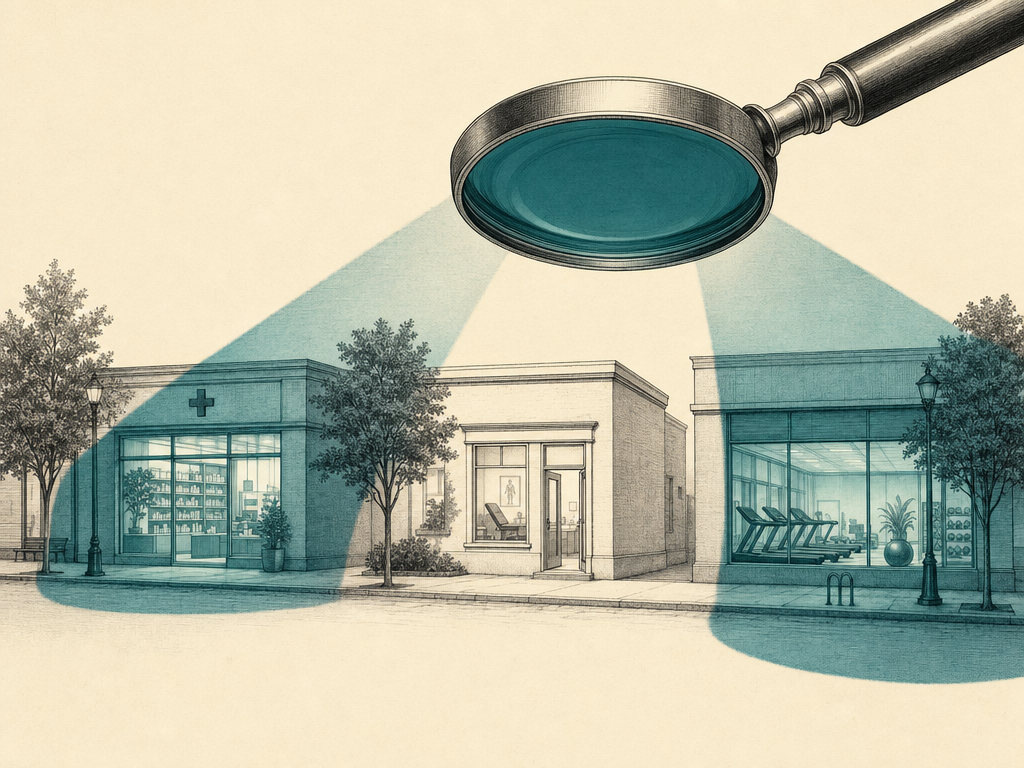
If ChatGPT, Perplexity, or Google AI Overview names one or two clinics and yours is not among them, the patient may never see your website, your Google profile, or your five-star comments. In that moment, you did not lose a ranking. You lost the chance to be considered.
I am not claiming a dataset of a thousand clinics. I have run visibility checks this quarter, including healthcare-adjacent local queries, and I have seen a pattern worth taking seriously: polished clinic assets can be ignored when the wider web does not describe the clinic clearly enough for AI to trust the recommendation.
How AI engines actually assemble a local clinic recommendation
AI engines assemble a local clinic recommendation by combining your business profile, website content, third-party pages, and the wording of the patient's question. They are not simply copying the first blue link from Google. Google itself has described AI Overview as drawing from a network of web sources rather than a single ranked page, and the same behavior is publicly documented in the Google Search Central documentation on AI features in Search.
This is where AEO, or Answer Engine Optimization, separates from traditional SEO. SEO asks, "Can my page rank?" AEO asks, "Can an answer engine understand, verify, and name my clinic in response to a real patient question?" If you want the broader foundation, I have grouped the basics in the AEO & AI Visibility cluster.
In 2025-2026, Google AI Overview and ChatGPT's live web search are active parts of how people look for local services. Perplexity also shows how answer engines can cite and summarize web sources. The behavior differs by platform, but the clinic visibility problem is similar: AI looks for enough evidence to answer with confidence.
For a clinic, that evidence can include:
- Your Google Business Profile name, category, address, hours, and reviews
- Your website pages for doctors, specialties, services, conditions, and locations
- Directory listings and healthcare profiles that repeat the same facts
- Mentions from local publications, associations, or relevant community pages
- Content that matches how patients describe their problem
Think of it like a referral letter. One clean note helps. Several independent notes saying the same thing, in language the patient understands, give the AI engine a stronger reason to include you.
Why strong Google reviews and a polished website are not enough on their own
Strong Google reviews and a polished website help, but they do not prove enough to an AI engine if the same facts are not reinforced elsewhere. This is where I want to push back directly on a popular view: a good Google Business Profile is not sufficient for AI visibility, and treating it as sufficient is how clinics with excellent local reputations end up invisible in AI answers.
I hear this assumption from clinic owners regularly. The reasoning goes: my profile is verified, my reviews are excellent, my hours are accurate, so surely I show up. That reasoning worked for traditional local search. It does not carry over cleanly to answer engines. An AI system is not counting stars; it is assembling a description it can defend. If the only voice describing your clinic in patient language is you, the engine has one source. AI engines are cautious with medical recommendations, and a single self-authored source is thin ground for the confident naming a patient hears back.
Your Google profile may tell AI that you exist. Your website may explain your services. Reviews may show patient satisfaction. But if the wider web does not connect your clinic with the exact specialty, city, doctor names, services, and patient-facing terms being asked about, the engine has less to work with.
This article is not arguing that SEO, Google Business Profile, or reviews are useless. They are foundational. The waste begins when clinic owners treat them as the whole visibility system and stop there.
The third-party corroboration gap: what AI needs to see about your clinic on other sites
Third-party corroboration means other credible pages repeat and support what your own clinic says about itself. In plain terms: AI wants to see that you are not the only source making the claim.
For a clinic, useful corroboration can look like a healthcare directory showing the same doctor name, specialty, address, and service area. It can be a professional association profile. It can be a local article mentioning the clinic's specialty. It can be a review platform where patients describe the care in natural language, not just a star rating.
This is not about chasing random backlinks. A backlink is just a pathway. Corroboration is a matching set of facts.
For example, if your website says you offer physiotherapy for sports injuries, your Google profile says "physical therapy clinic," a healthcare directory lists your therapists, and patients on a review site mention knee rehab or shoulder pain, AI has a clearer picture. If those sources conflict, or if they only say "wellness center," the picture gets blurry.
To be honest about the boundary: I call this the most-missed piece because it is the one clinics overlook, not because I have ranked it against the other two as the biggest lever. All three matter. This one just tends to be invisible to the people who need it.
Schema belongs here too, but let me explain it without SEO-blog language. Schema is like putting labels on the clinic file so a machine can read it correctly: doctor, clinic, address, specialty, service, review, article. Schema.org publishes healthcare-specific types, MedicalBusiness and Physician among them, and clinic websites do not commonly use them. Schema helps when the page already says something specific and true. It does not rescue vague content.
The language gap: how patients phrase things to AI versus how clinics describe themselves
Patients ask AI in problem language, while clinics describe themselves in professional language. That gap can keep a clinic out of answers even when the clinic is clinically relevant.
A clinic may write, "advanced dermatological solutions," while a patient asks, "Who can help with sudden hair fall near me?" A dental clinic may write, "restorative dentistry," while a patient asks, "Where can I fix a broken tooth today?" An IVF clinic may write about "assisted reproductive technology," while the patient asks, "Which fertility clinic explains IVF clearly?"
The answer is not to dumb down medicine. It is to translate the clinic's expertise into the words patients actually use before booking.
Useful pages answer questions like:
- What symptoms or concerns do patients bring?
- Which doctor or department handles them?
- Which location serves that patient?
- What should a patient expect before the first appointment?
- What terms might a non-medical person use for the same issue?
In my novel The Unaided Minds, I explored how people think when technology starts answering for them. That question is practical here. If AI becomes the first interpreter between patient and clinic, your website must speak to both.
How solo doctors and small clinics can compete with hospital chains in AI answers
Solo doctors and small clinics can compete by becoming easier to understand, verify, and match to specific patient questions. They do not need to sound like a hospital chain.
A hospital has scale. A smaller clinic can have clarity. AI answers are not only about who has the largest site. They also depend on whether the engine can identify a strong match between the patient's need and the available evidence.
A small dermatology clinic can publish a page on acne scar treatment in its city, name the doctor, explain the consultation process, keep its Google profile accurate, and make sure healthcare directories repeat the same facts. A physiotherapy clinic can create separate pages for sports injury rehab, post-surgery rehab, and back pain, then align those descriptions across trusted profiles.
This is where local specificity matters. "Dental clinic in Mumbai" is broad. "Pediatric dentist for anxious children in Bandra" is more usable by an answer engine when the claim is supported across your site and outside sources.
Do not imitate corporate healthcare language. Be accurate, specific, and patient-readable. A small clinic's advantage is that it can fix unclear pages and inconsistent profiles without waiting for a national marketing department.
How to check what AI is saying about your clinic today, and what to do in the next 30 days
You can check your current AI visibility by asking the same questions a patient would ask and recording whether your clinic appears, how it is described, and which sources are cited. Do not start with your clinic name. Start with the patient need.
Try prompts like:
- "Who is a good dermatologist near me for acne scars?"
- "Which pediatric dentist near me is good for nervous children?"
- "Where can I find physiotherapy for sports injury recovery in [city]?"
- "Which clinic near [area] treats hair fall?"
Run the same question in ChatGPT with live search, Perplexity, and Google AI Overview where available. Then write down four things: whether your clinic appears, which competitors appear, what wording the AI uses, and which sources it seems to rely on.
For a deeper primer on this process, use the AEO & AI Visibility cluster as the starting point.
In the next 30 days, do not promise yourself an AI ranking. That is not how this works, and I will not manufacture a timeline. Instead, complete these actions:
- Update your Google Business Profile categories, services, hours, and location.
- Rewrite one service page in patient language.
- Add doctor names, specialties, and location details where they belong.
- Check major healthcare directories for consistency.
- Collect the exact phrases patients use in calls, reviews, and appointment requests.
- Run the same AI prompts again and record what changed in the answer.
This week, choose one specialty and one city or area. Ask ChatGPT, Perplexity, and Google AI the patient-style question for that service, save the answers, list the sources they mention, and fix the first mismatch you find between your website, Google profile, and third-party listings.
Frequently asked questions
How does an AI engine decide which clinics to recommend when someone asks for care nearby?
An AI engine builds an answer from several signals: local business data, website pages, third-party profiles, reviews, location terms, and the wording of the patient's question. It is not only looking for a clinic with a nice homepage. It is trying to decide which clinic can be understood and verified for that specific need. If your clinic's facts are scattered, vague, or inconsistent, the engine has less confidence when naming you.
Is a good Google Business Profile enough to get recommended by AI?
A good Google Business Profile helps AI understand that your clinic exists, where it is, what category it belongs to, and what patients say about it. But it is not enough by itself. AI also needs a website that explains services in patient language and outside sources that corroborate the same facts. Treat the profile as one part of the evidence system, not the entire system.
Why do some clinics get named by AI while others with better reviews get ignored?
Reviews are useful, but AI recommendations depend on more than review quality. A clinic with fewer visible review signals may still be named if its specialty, location, doctor information, services, and third-party mentions are easier to connect to the patient's question. A clinic with strong reviews can be skipped when those other signals are vague, conflicting, or written in language that does not match what patients ask.
Do patient reviews on third-party sites matter more or less than my own website?
The better question is what each source proves. Your website explains what you offer, who provides care, where the clinic is, and what patients should expect. Third-party review sites and directories can corroborate those claims from outside your own domain. AI engines use that wider evidence to reduce uncertainty. Your website and third-party mentions work together when they describe the same clinic clearly.
How can a solo doctor or small clinic compete against hospital chains in AI answers?
A solo doctor or small clinic can compete by being specific, consistent, and patient-readable. Create clear pages for the services patients ask about, connect those pages to doctor names and location details, and make sure outside profiles repeat the same facts. You do not need corporate language. You need enough clear evidence for the AI engine to match your clinic to a patient question.
How do I check what AI is currently saying about my clinic today?
Open ChatGPT, Perplexity, and Google AI Overview and type the questions a real patient would ask: a doctor in your specialty and city, someone who treats your specific conditions. Watch whether your name appears and how you are described. Try several phrasings. Then search your clinic name to see which independent sources describe you and whether they agree with your website. That combination gives you a clear baseline of your current AI visibility.
What can a clinic realistically do in the next 30 days to become more visible to AI?
A clinic can audit what AI says today, correct inconsistent listings, rewrite one or two important service pages in patient language, and align Google Business Profile details with the website. It can also gather the phrases patients use when calling or reviewing the clinic. These actions do not guarantee a timeline for AI recommendations, but they improve the evidence AI can use when evaluating your clinic.